Data Types
- Nominal
- Ordinal
- Interval
- Ratio
Nominal data
- Nominal data = a category
- Latin word nomen – pertaining to names.
- Nominal data consists of named categories in which the data fall.
- Nominal data is unordered with no mathematical values.
- It is a type of data that is used to label variables without any quantitative value
- Nominal data can be counted and used to calculate percent, but you can’t take the average
- When there are only two categories available the data is referred to as dichotomous.
- Example
- Grocery categories
Ordinal data
- Ordinal = order
- No category on an ordinal scale has a true mathematical value.
- Numbers are assigned to the categories to make the data analysis easier.
- Example
- Positions in a race
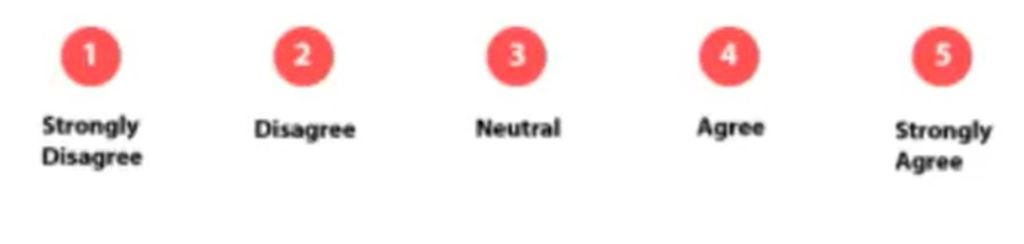
- Survey questions that have answer scales like strongly disagree, disagree, neutral, agree and strongly agree – seen in figure 2
Interval data
- Interval data is a data type which is measured along a scale, in which each consecutive point is placed at equal distance from one another.
- Interval data is numeric
- Interval data doesn’t have a meaningful zero point.
- The value of zero doesn’t indicate the absence of the thing your measuring.
- The lack of a zero point makes comparisons of direct scales impossible.
- Scenario
- 0am isn’t the absents of time, it just means it’s a start of a new day
- A temperature of zero doesn’t mean there is no heat.
- Examples
- Temperature
- Time of day
- Calendar
- Years
Ratio data
- Ratio = numeric
- Ratio data is defined as a quantitative data.
- It does have a meaningful zero point.
- The values of zero indicates an absence of whatever your measuring.
- Zero means you don’t have anything of that type
- Scenario
- Zero minutes
- Zero people in the line
- Examples
- Height
- Weight
- Age
- Time
- Money

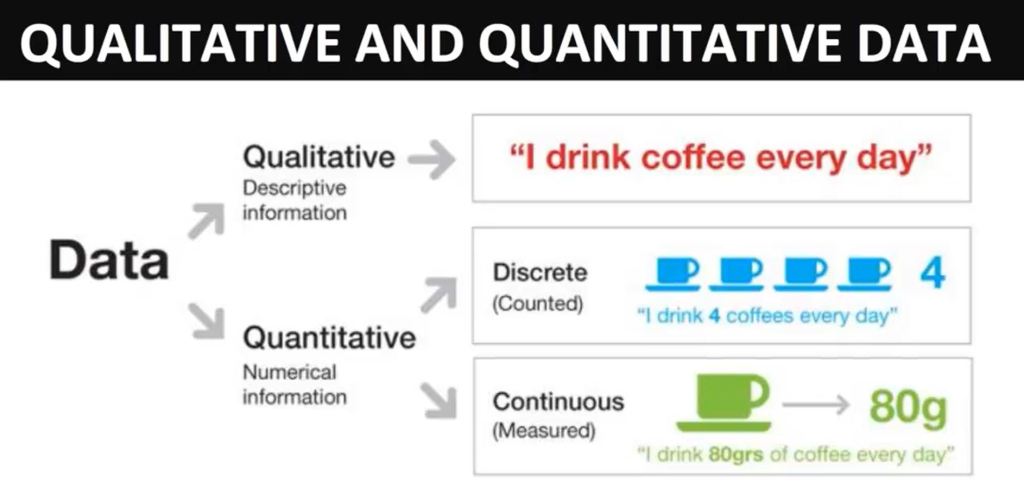
Qualitative data
- Refers to non-numeric data
- Descriptive and information
Quantitative data
- Refers to numeric data; quantifiable
- Numerical and information
Reflection
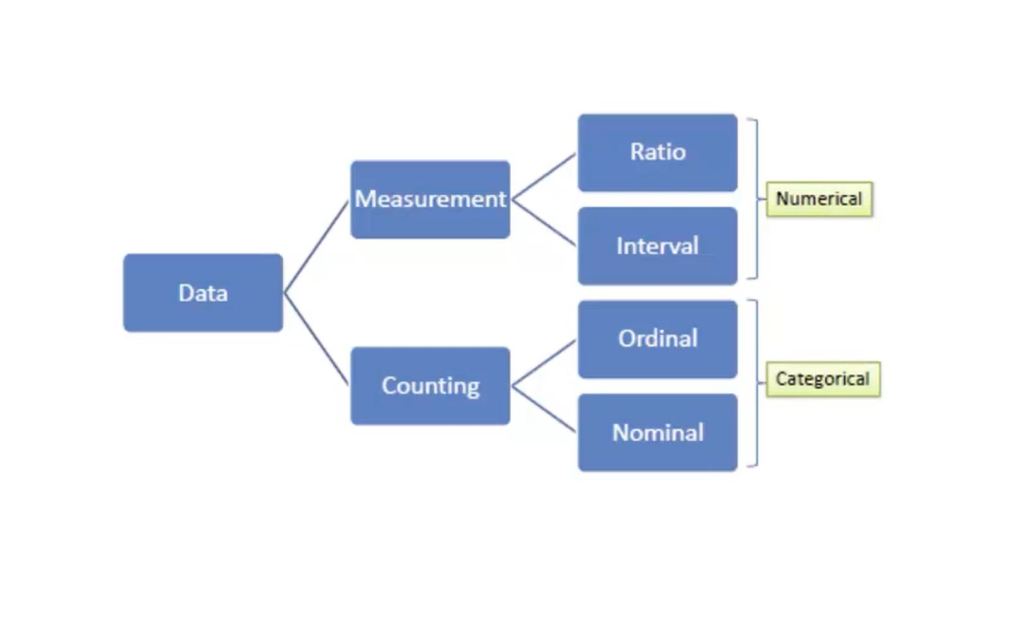
Data can be organised into categorical and numerical data. Ordinal and nominal are categorical data which means that the data is collected in groups or categories. Numbers don’t often make sense unless meaning assigned to those numbers. Interval and ratio are numerical data. Numerical data is data that is measurable like height, weight, etc. You can sort the data in either ascending or descending order.
 the art of data